
Work isn't life or death
Letter #90: A throwback to two life or death stories that change the way we prioritize the stress of work in life.

One of my dear friends texted me this past December to check in, say hi, and see how I was doing.
She was actually quite shaken, and her checking in wasn’t for me, but for her to lean on a friend and get some love—something I’m more than happy to dole out.
She’d been to a concert that weekend in Vancouver, BC with another friend. When their short trip came to a close, my friend flew from Vancouver back to Winnipeg, where she picked up her electric car at long-term parking to begin the two and a half hour long drive back to her husband’s family farm in northwestern Minnesota. It was a routine trip, a straight shot, and she left the airport that afternoon with ample time to reach border patrol before it closed.
The car was plenty charged, she was plenty awake with caffeine, and ready to be home in her own bed with her husband and her dog.
But things didn’t go as planned. A white-out blizzard hit out of nowhere. She went from having plenty of battery in her car, to crawling along the freeway at a 20-mile an hour pace, relying only on the car’s computer to detect where the lines of the freeway actually were. Her visibility was zero.
She called her husband, who was in Texas for work at the time, to let him know what was happening. When he looked up her location through their mutual app, she could hear the panic in his voice—a sound she was not used to hearing from this hardy Minnesota farm boy.
There wasn’t a charging station within range and the car was losing battery quickly due to the frigid temperatures and crawling pace. The car’s GPS had unknowingly re-routed her to find a charging station—she wasn’t going to make it to border control before it closed.
Her husband, in his best efforts not to sound frantic, asked what clothing and resources my friend had in the car. Feeling ill-equipped, admitted she had her best concert outfits for the weekend (aka nothing to protect her from a blizzard), and little else to keep her warm. Her husband warned her that if anything happened—if she spun out, if the car finally lost battery, or something worse—whatever she did, she COULD NOT leave the car. That to leave the car and step into the blizzard could mean she’d freeze to death.
Long after the fact, as my friend was recounting this story to me over text, my responses were wildly desperate to know how it ended. “WHAT?!”…."Wait…WHAT?! OMG!” It felt like I was reading the manuscript to a thriller film.
Miraculously, her husband was able to re-route her to a tiny charging station miles away from their traditional route. She was able to reach it with a mere 2% of battery left in the car. By this time, it was about 3am. Since border control was closed, she slept at the charging station in her car, bundled with whatever clothing she had in her luggage, until 7am. She’d been in the car over 12 hours—for what should’ve been a two and a half hour drive—and there were several times she feared she could die that night.
And you know what was one of the main thoughts going through her head? I tear up writing this…
That the stress of her job was not worth it. That, at the end of the day, the emotional energy she pours into a place that will never honor and protect her is not worth taking away the time of enjoying the beautiful life she’s built for herself—her loving husband and their home, their sweet dog, their close group of friends and family members.
Her story hit me really hard. I was already two years out of my NYC job and so many similar feelings came rushing back.
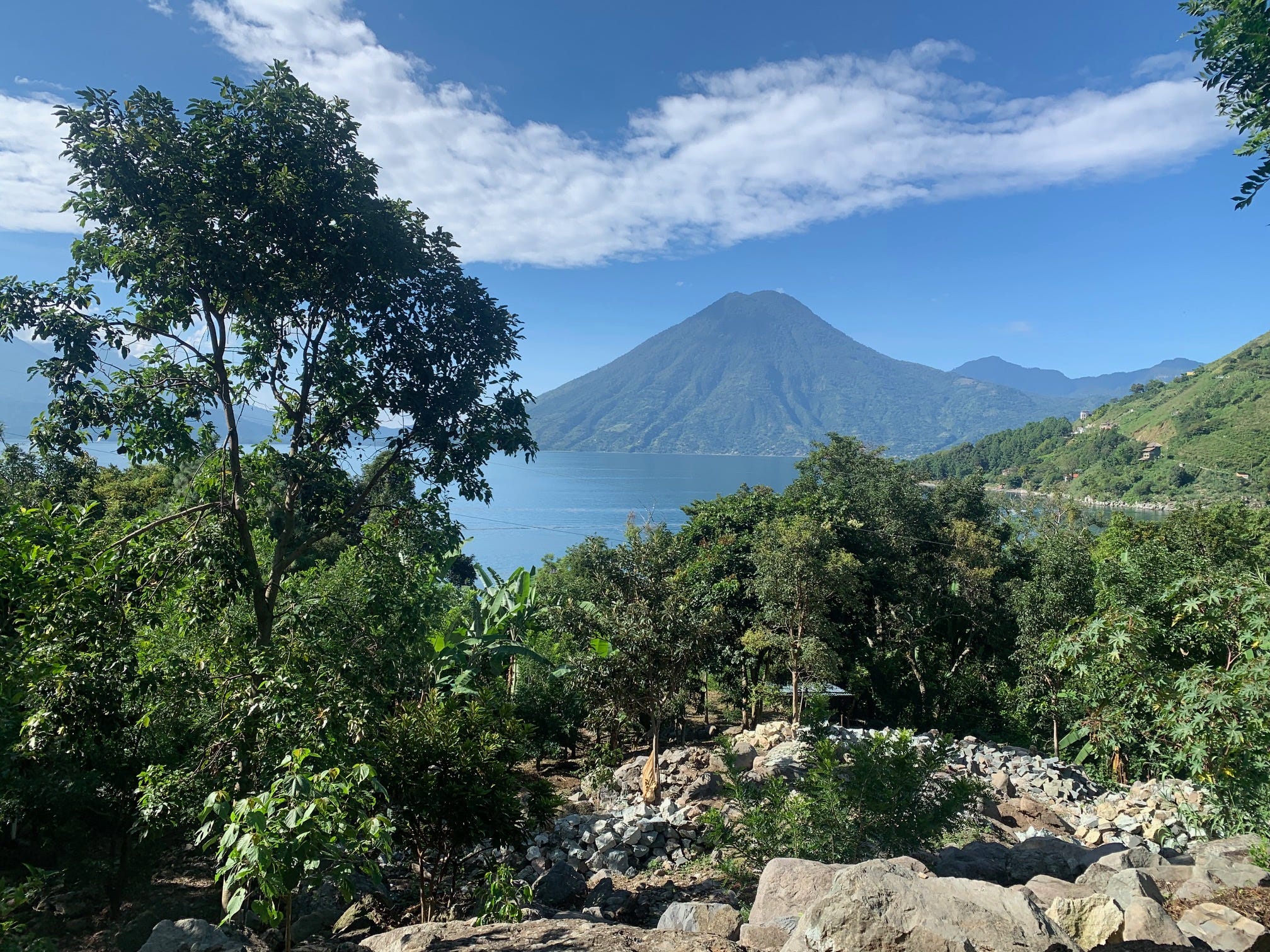
In September 2021—exactly one year before I put in the three weeks notice at my fashion job of ten years in NYC—I took a solo trip to Guatemala. I was staying in a beautiful little eco-bungalow on Lake Atitlán called Maya Moon Lodge. I had recently broken up with a swift romance and desperately needed some time alone to reflect and reset.
I loosely became friends with two of the women working at the lodge—both from the US and working and living at the lodge for a period of time. One afternoon, they asked if I’d be interested in joining them for a hike through the woods, across the coffee plantation, and over into the next town for brunch the following day. Normally I’d cringe at an 8am meet-up time on vacation, but because the time difference was working in my favor, I found myself awake most mornings around 5:30am and able to catch the sunrise over the volcanos. So I agreed to meet them early the next morning for a trek.
I filled my trusty S’well water bottle and we set out—the hike was only to be about an hour and a half. We’d reach the next town by 10am, have brunch, and I’d get back to the lodge for a Zoom meeting for work by noon.
We trudged up the street through the small town of Tzununa, and then turned into the woods, hiking up the small mountain and along a ridge. The lodge family dog—a yellow lab—came along for the trek. As the trail narrowed, the three of us fell into a single file line, with the dog leading the way. At some point we entered the coffee plantation part of the mountain—Helen and Sarah pointed out the coffee plants dotted along the ridge. We began our descent around the other side of the mountain—the trail had a sharp drop off just to our left and was lined with heavy brush up the mountainside to our right.
The woman at the front of the line—Helen—disappeared around a bend in the trail—Sarah and I were following several paces behind.
All of a sudden, Helen let out a blood-curdling scream, followed by intermittent screeches of panic. Sarah and I stopped dead in our tracks, calling out to Helen.
“What is it?! What’s happening?! Are you okay?!”
Helen continued screaming. The thoughts going through my head became very dark—whatever she was seeing or experiencing around that bend must’ve been terrifying enough to warrant such a strong reaction.
Helen finally screamed out “BEES!!!!!!” She was being attacked. Sarah and I could hear them—the low, vibrating hum of some very angry bees. We called out, asking desperately what Helen needed. She yelled out “WATER!” Sadly, I called back that I was out of water—a mistake I’ll never make while hiking again. Sarah and I quickly contemplated what to do. I reasoned that if Helen was stuck in a swam of angry bees, there was no way we could circumvent the swarm to help her. It was either run right into the nest ourselves, or tumble down the deep drop off to our left. We were trapped.
The dog ran back up the trail towards Sarah and I, yelping as the bees followed her. While far fewer, those bees began biting Sarah and I. I was struggling not to panic and swatting them away.
We began screaming repeatedly for Helen to run—it was the only way she could get out of this. To run down the trail and head towards town, where hopefully she’d find help. She was sobbing at this point—calling out that the bees were stuck in her hair, biting her1 scalp, over and over. She continued to scream for water. Sarah and I felt helpless. We couldn’t see Helen. We could just hear her intermittent shrieking between the sobs of pain. I was terrified of what would happen to her. The bees could kill her. Or, blinded by the pain, she could stumble over the ridge and down the mountain.
Eventually we heard her voice trailing away. Helen was running through the woods screaming for help. The dog must’ve followed her. As Helen’s voice grew fainter, Sarah and I stared at each other, shocked and unsure what to do next. We headed slightly back up the trail and away from the trailing bees that continued biting us. Both our cell phones offering little to no service, we agreed Sarah would retrace our steps back along the trail to see if she might run into someone that could call for help—someone that could find Helen on the other side of the mountain. I would stay put and Sarah would come back to find me. I repeated over and over “please don’t let Helen die. Please.”
I stood in the woods alone and in silence for only a couple minutes before I started to panic again. I was too freaked out to stay up there by myself so, while I knew I was deviating from our plan, I tried to follow the trail back the way we came. I was half jogging along the trail before I realized I didn’t recognize where I was. I was in a clearing, higher up than we had gone before, and knew I was getting myself lost. I checked my phone and had one bar of service.
I called Hilary immediately. I told her what was happening and that I was scared. She was calm and patient and urged me to take deep breaths. She told me to stay where I was—that I absolutely must not move and trust Sarah will come back to get me. She knew that if I got lost any further (and without water) it could be dangerous.
I don’t recall how long I waited—20? 30 minutes?—before I finally heard Sarah calling my name. I began running towards her voice, utterly relieved and grateful she came back for me.
Sarah had met two locals on the trail who called into town to have someone look for Helen on the other side.
Sarah and I backtracked through the woods back into Tzsununa. Eventually Helen called Sarah—she was ok. She encountered two men who were trekking up the mountain to tend to the coffee plants. When they saw her, they immediately ripped off their sweaters and wrapped them around her hair, killing the bees that were coated in her hair and biting her over and over.
The men escorted her back into the town that we were meant to end at for brunch. The lodge owner met Helen and drove her back home.
Sarah and I were relieved beyond measure. We recounted what happened over and over, unsure how we could’ve changed anything about it. We felt horribly that we hadn’t run to Helen’s aid. And yet I knew three of us stuck in a bee nest would’ve prevented any of us from being able to find help.
I vowed never to travel with so little water again.
As Sarah and I reached the town, I checked my phone and saw that if I was back at the lodge in the next 30 minutes, I’d make my Zoom meeting for work. We stopped at a stand for fresh coconut water to rehydrate ourselves and headed towards the lake, back to the lodge.
I reached my room with 5 minutes before the meeting started. I was dirty, sweaty, shaking, and feeling disoriented by what I had just experienced. It was an odd sensation to then put on my “work hat” and jump on a video call to discuss the production for the following season.
The meeting was business as usual until the CFO began asking about costing for an underwear product I had designed that was now far along in production and getting ready to ship. The costing negotiation between the production manager and the factory had never been finalized, and now the factory was backtracking on price, charging us higher than previous seasons. Our margins were shot.
While I was not the one negotiating the pricing with the factory, I was the designer of the product and the onus fell on me—the production manager stayed silent. The CFO was now raging, claiming I had lost the company $150,000 out of negligence by not finalizing the pricing months ago. I was shocked at the turn of events, wracking my brain as to what sort of email evidence I had that we were, in fact, not losing that much money due to the factory raising the price.
When the call ended, I sat there, stunned. I looked out over beautiful Lake Atitlán, recalling that only an hour earlier I was lost in the woods on a mountainside in Guatemala, and the friend I had gone trekking with could’ve died from a bee attack. And now here I was panicking that I may lose my job because of a pricing mistake.
What the f*@% was I doing with my life? What is the point of all this? Of working for money-hungry executives that berate and humiliate you for making one wrong move (out of SO MANY right moves)? Sure—it was an expensive wrong move that had been made, but the production manager with a far higher salary than mine so conveniently stepped out of the frame so I could take the fall.
Did any of this really matter? It’s just f*@%ing underwear. No one died. No one actually needs to buy and rebuy and buy again this mass-produced, branded item. It won’t make these consumers happier, it won’t bring them peace.
I was visiting one of the most beautiful places I’d ever been and had just experienced one of the scariest moments of my life. All I wanted to do was go check on Helen and Sarah, and recount our story in relief and camaraderie. Instead, I poured over past emails and spreadsheets, looking for any evidence that the factory had made a mistake and we hadn’t lost that much money.
I recovered what I could of the emails, and sure enough—the production manager had dropped the ball on the negotiations. I reached out to beg they reconsider the pricing. I forwarded what I’d found to the CFO and the team, apologizing for my oversight and vowing never to let a miscommunication like that happen again.
I then vowed to myself that this isn’t the life I wanted anymore and I would do whatever I could to change it. It would take another year for me to unravel myself from the financial dependency on this job that brought me so much fear and heartache, but I eventually left. The experience I had on the mountain that day was dangerous—it was life or death. Functioning as a cog in the wheel for a company that thrives by sucking the mental and emotional energy of its employees…wasn’t. It wasn’t life or death. And from that day forward, I’ve learned to care less about work. To check my priorities in life. To check my loyalty to myself and my happiness. My friend has since done the same—that blizzard she experienced in Canada changed everything about how work was prioritized in her life.
And never again will I allow a man to scream at my like that after having a real life, real scary experience. It just ain’t worth it.
If you’re enjoying On the Road, please share with others who you may think would enjoy as well! As always, I love reading your comments and feedback. If you're not already subscribed, please click the button below so I can continue sending you stories about travel, life, feelings, and experiences. 🚙
Whoa, I don't think I have heard that hiking story before! I was excited to see this post show up!
What an INCREDIBLE read hk!! And SUCH a poignant reminder- each day is a gift - how can we try and honor that better❤️